
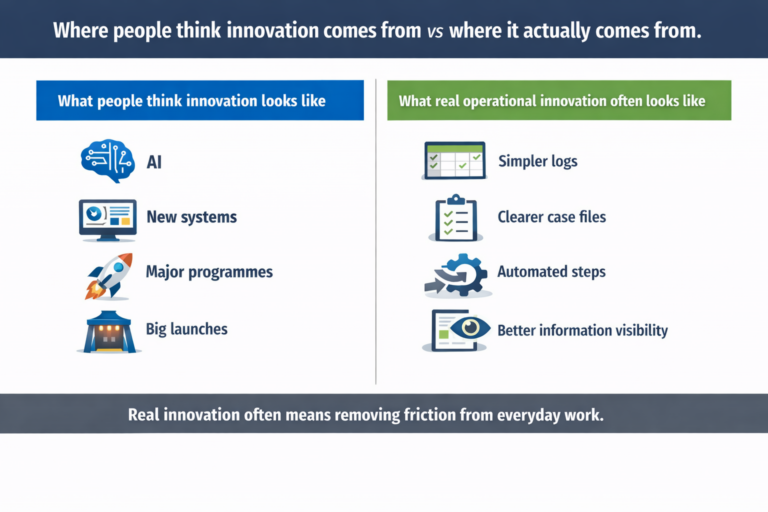
When people talk about innovation in social care, the conversation often focuses on technology.
- AI.
- New platforms.
- Digital transformation programmes.
- Major system-wide initiatives.
Those things can be really valuable. Technology can absolutely help improve services when it’s used well. I’m working on one of a tech platform myself! But how often have we seen software or technology dictate how we work rather than support our work?
In my experience, most meaningful innovation in charities and social care looks very different.
It rarely arrives through a big launch or a major programme. More often, it comes from people quietly improving how things actually work. Fixing a process that has slowly become inefficient. Clarifying who is responsible for a decision so work doesn’t stall. Improving governance so that issues are identified earlier and handled properly. Building stronger collaboration between organisations so problems can be solved rather than passed around.
These changes don’t usually get labelled as innovation. They often look too ordinary. Over time, working across charities, local authorities and wider care systems, I’ve become increasingly interested in this kind of operational improvement. Not the headline-grabbing projects, but the quieter work of improving processes, governance and collaboration so that systems function more reliably for the people who rely on them. It starts with finding friction and then doing something about it. I’ve often found ideas through our ISO9001 process, staff feedback, trying to use a process myself, or observing the frustration that suboptimal processes and systems create.
But they are often the things that make the biggest difference. One change I’ve made that was particularly well received by a member of staff was adding some formulas to a Rota spreadsheet so that they had a quick reference dashboard that confirmed every shift was covered without having to look through the whole thing.
In complex systems like social care, small operational improvements can have huge effects. When the underlying processes are clearer, when responsibilities are understood, and when organisations trust each other enough to work through problems together, the whole system functions better. Without those foundations, even the most impressive new technology will struggle to make a real impact.
This kind of improvement work isn’t always visible. It rarely makes headlines. But it’s the work that enables services to be safer, more responsive, and more reliable for the people who depend on them.
I’ve seen this particularly clearly in areas like safeguarding, where good governance and clear processes are essential. Sometimes the most valuable improvements come not from new tools, but from strengthening the systems that sit behind the work. That might mean improving reporting processes, clarifying accountability, or making it easier for concerns to be raised and addressed quickly. None of that sounds particularly glamorous. But it’s exactly the kind of operational improvement that helps organisations protect people more effectively.
Innovation in social care doesn’t always look like a new product or a major transformation programme.
Quite often, it looks like someone asking a simple question:
Why do we do it this way? Or could we make this better or easier?
And then taking the time to quietly do just that.